
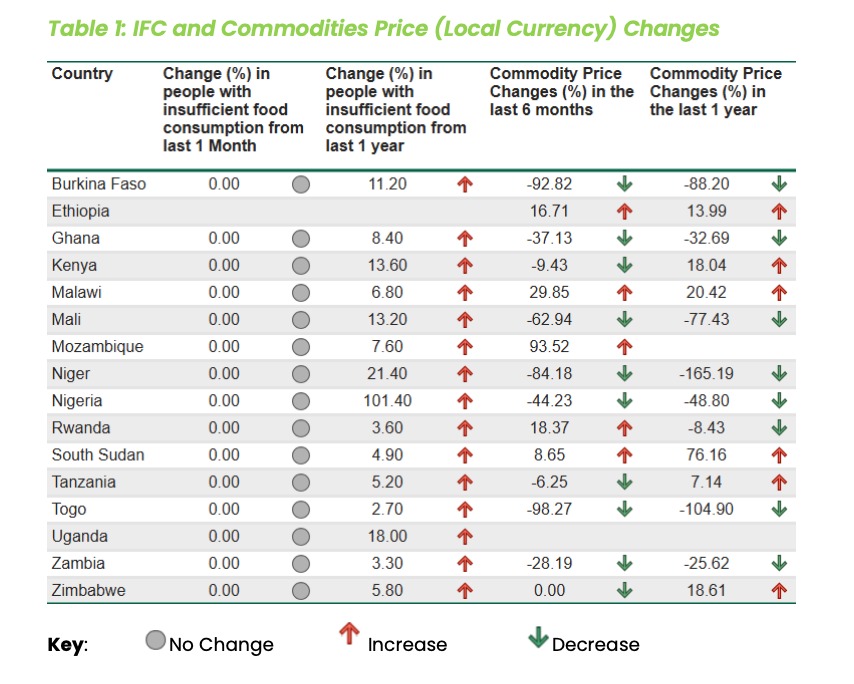
The average price of food commodities in Ghana has dropped by 32.69% over the last one year, according to the November Food Security Monitor report published by AGRA. The report which tracks food security situations across 17 countries in Eastern, Southern, and Western Africa says the average decline in prices over the last six months has been even sharper, at 37.13%.
https://agra.org/wp-content/uploads/2025/12/Food-Security-Monitor_Nov-2025_Final.pdf
“On the price front, all monitored West African countries have experienced drastic drops in their commodity prices over the past six months and one year due to increased supplies from recent harvests. Over the past six months, imported rice prices fell sharply in Burkina Faso (92.8%), Mali (62.9%), and Niger (84.2%), while maize prices declined significantly in Ghana (37.1%), Nigeria (44.2%), and Togo (98.2%),” the report noted.
Between October and November 2025, the report says, “West Africa’s staple food markets show broad price easing with isolated volatility driven by improved supply from harvests and seasonal inflows.” The report says average maize prices per metric tonne on the Ghanaian market fell sharply over the one-month period from US$407 to US$374, down 8.1%, likely reflecting improved supply from recently concluded harvests. In Togo, the price fell from US$338 to US$304, down 10%, signaling regional normalization.
Rice price per metric tonne softened across most markets between October and November, led by Nigeria’s steep drop from US$586 to US$508 per MT, down 13.3%, followed by Ghana (down 9.2% from US$1,157 to US$1,051), Togo (down 7.7%), and Burkina Faso (down 7.5%), while Mali remained stable. Millet recorded the largest decline in Niger (US$407 to US$327, down 19.7%), with Burkina Faso also falling 8.1%, while Nigeria edged up 2.2% on localized demand. Sorghum prices decreased broadly, with Niger down 9.9% and Burkina Faso down 7.7%. Overall, these downward adjustments reflect improved availability and harvest inflows, though isolated volatility persists in some markets. The monthly Food Security Monitor report produced by AGRA is supported by the Gates Foundation, The Rockefeller Foundation, the UK International Development.
Difficult grains market in Ghana
The report notes that in Ghana, over 1.2 million tonnes of rice, maize, and soybeans remain unsold, with farmers unable to cover production costs. The report says the National Buffer Stock Company’s additional GHS 200 million (US$ 18 million) in procurement funding has proven insufficient to absorb the surplus. “The government is maintaining the grain export ban to keep food prices low, with no timeline for lifting restrictions. Regional informal trade channels that previously absorbed surplus have been disrupted by military rule in Burkina Faso and policy changes in Nigeria,” it says.
“Meanwhile, markets are flooded with smuggled rice entering through Togo and Côte d’Ivoire borders, with politically connected traders and institutional buyers sourcing mixed supplies,” the report observed.
“Farmers and processors are planning to reduce production or change crops for next season in response to sustained losses,” the report warned.
In West Africa, harvesting of main-season cereals is nearly complete under generally favourable conditions, supported by average to above-average rainfall and adequate distribution throughout most of the season. While some areas experienced localized impacts from rainfall deficits and flooding, overall weather patterns were conducive to crop development. However, production outcomes remain constrained in regions affected by persistent insecurity and socio-economic challenges. Aggregate cereal output for the subregion is projected at 82.9 million tonnes, representing a 10.4% increase over the five-year average and 7.3% above last year’s campaign, signaling strong regional performance despite localized constraints.
General food security situation
The report however notes the percentage of people dealing with Insufficient Food Consumption (IFC) in the Ghana has gone up by 8.4% over the last one year, and 55.6% over the last two years. The report characterizes Ghana’s IFC situation as moderately low, with 23.96% of the population, representing about 8 million people, battling with the situation.
People facing IFC refers to those with poor or borderline food consumption, according to the Food Consumption Score (FCS). The Food Consumption Score (FCS) is a proxy indicator for food security that measures the diversity of household diets and how frequently food is consumed.
Poor food consumption typically refers to households that do not consume staples and vegetables every day and never, or very seldom, consume protein-rich food such as meat and dairy. Borderline food consumption typically refers to households that consume staples and vegetables every day, accompanied by oils and pulses a few times a week. Acceptable food consumption typically refers to households that consume staples and vegetables every day, frequently accompanied by oils and pulses, and occasionally meat, fish and dairy. The report says the number of people facing IFC has worsened across all monitored countries compared to last year, with the steepest increases recorded in Nigeria (+101.4%), Niger (+21.4%), and Uganda (+18%).
The report says West Africa faces persistent and severe food insecurity, primarily driven by conflict, displacement, and market disruptions. Niger faces the most severe crisis with 76.6% (21.4M) of its population facing IFC. Mali follows at 52.4% (13.2M). Burkina Faso has 46.5% (11.2M), up 11.2% year-on-year. Nigeria has the largest absolute number, 56.4M (23.7%), with volatile trends, up +101% from last year but -37.5% over two years. Côte d’Ivoire has the lowest IFC at 15.6%, although up 5.1% year-on-year.