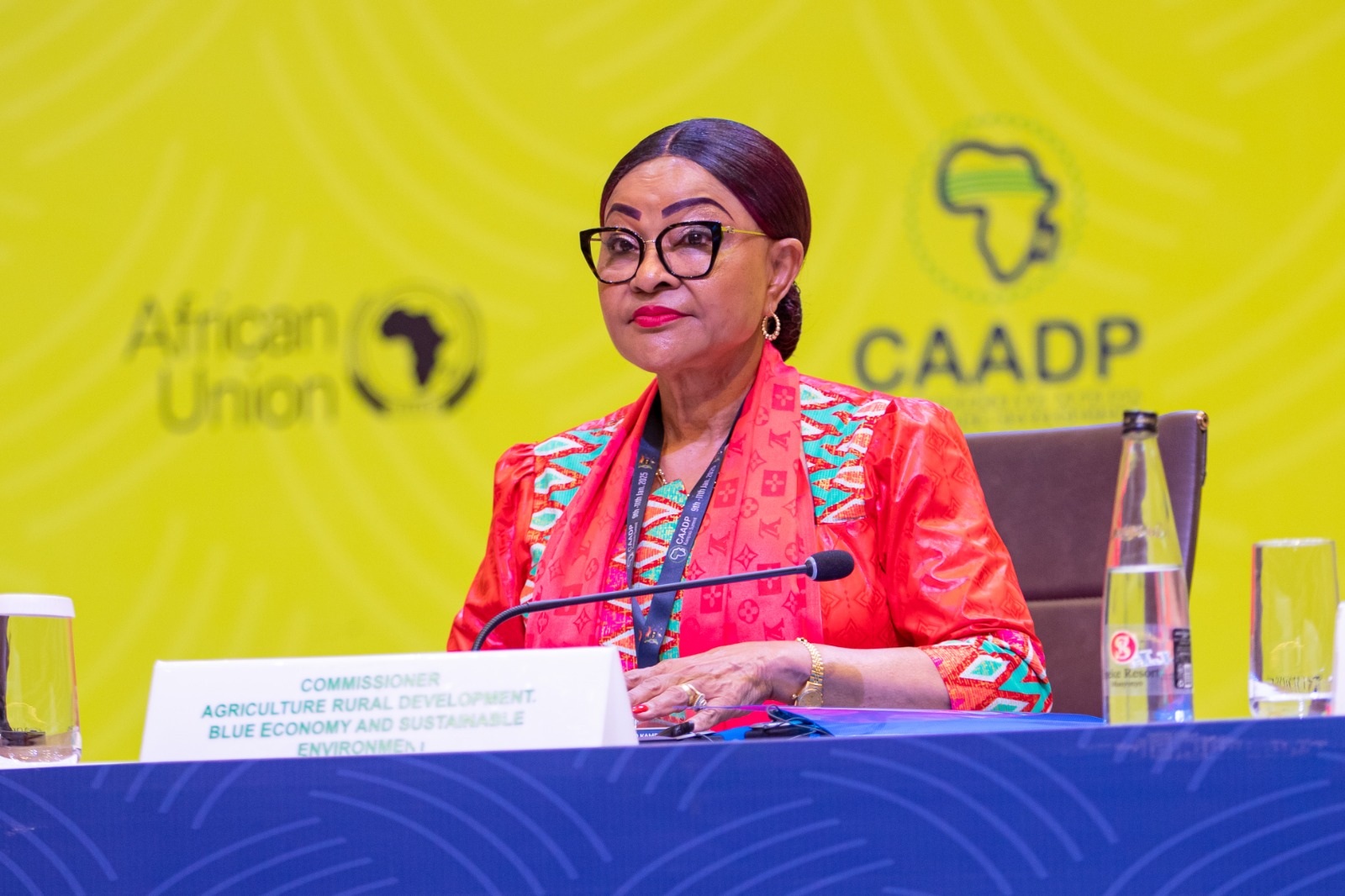
African Union Commissioner for Agriculture, Rural Development, Blue Economy, and Sustainable Environment Ambassador Josefa Sacko
African Union Commissioner for Agriculture, Rural Development, Blue Economy, and Sustainable Environment Ambassador Josefa Sacko has urged African youth to get involved in efforts to transform the continent’s food systems.
Speaking during a side event at the youth and women pavilion at the ongoing Extraordinary Summit on the Post Malabo Comprehensive Africa Agriculture Development Programme (CAADP), she said the youth have a lot of power to help transform food systems and they need to use that power.
“Advocate for your needs and take an active role in shaping the decisions that will shape your life. Your voice matters. Speak boldly about your changes. You make a lot of noise. Make noise in Africa so they can hear your voice,” she said. “Share your innovative ideas and inspire your communities by leading with creativity and purpose. The transformation of the African food system will not happen without your energy and your creativity,” Ambassador Sacko added.
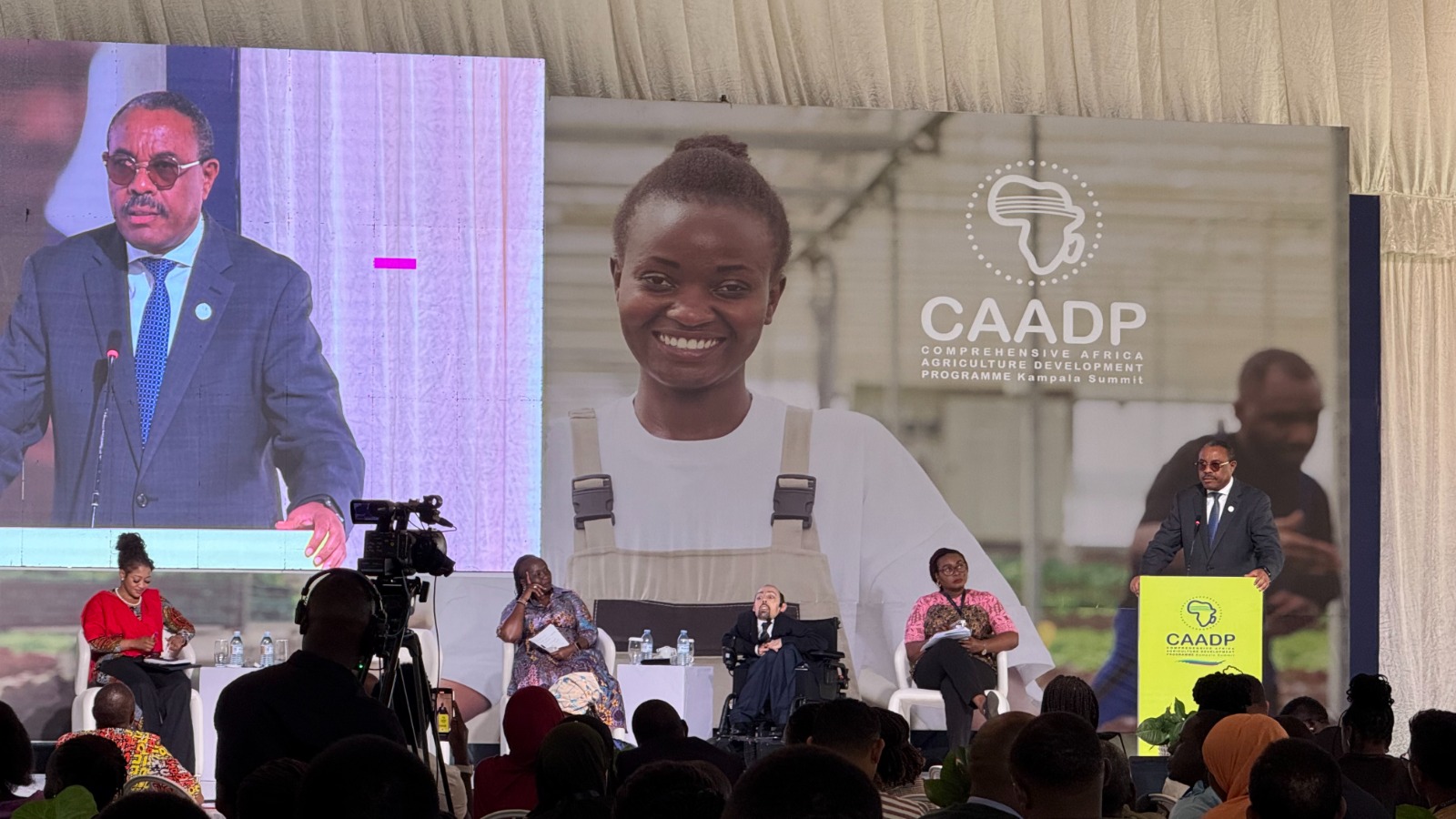
Board Chair of AGRA Hailemariam Dessalegn speaking at event
Board Chair of AGRA Hailemariam Dessalegn who also spoke at the event said only 11 countries in Africa are on track to meeting African Union CAADP’s goals for youth and women. He expressed concern a lot of the youth-focused policies are on shelves gathering dust and urgent action should be taken to implement them. He said there is a need for young people to take their future into their own hands.
“Our young people and women agripreneurs are not just participants in the agricultural landscape—they are innovators, leaders, and drivers of economic transformation. Their creativity, energy, and innovation will be the driving force behind the transformation of the continent’s agrifood systems,” he said. “This (new CAADP strategy) is an opportunity for young people and women to organize themselves and try to bring about the transformation we desire for ourselves. We should all come together,” he added.
Executive Director of the Consortium of African Youth in Agriculture and Climate Change Dr. Mwaka Namukonda speaks at side event
Executive Director of the Consortium of African Youth in Agriculture and Climate Change Dr. Mwaka Namukonda told the event: “the path of Africa’s transformation is paved by the youth and its women.” She said the upcoming 10-year CAADP strategy offers Africa the chance to prioritize youth and women in the efforts to transform food systems, but “it requires visionary leadership and action that moves beyond rhetoric.”
Director of Agrifood Systems & Climate at Mastercard Foundation Wambui Chege said Africa’s agrifood systems hold tremendous potential to ensure food security. She added the sector is uniquely positioned to create opportunities for young people, and the foundation will continue to support that.
“We are deeply committed to unlocking the potential of Africa’s young people, especially young women to drive lasting economic transformation. I am reminded of the young energy, resilience, and innovation that young Africans bring to this sector. It is this bold spirit that we must nurture and empower,” she said.
She said the foundation has so far committed $10.1 billion to programs that support young people to transition into dignified jobs, disclosing 13.3 million youth have been supported, of which more than half are young women in agrifood systems.
Over 2,000 participants, including African heads of state and government, are participating in the African Union (AU) Extraordinary Summit on the Comprehensive Africa Agriculture Development Programme (CAADP) in Uganda’s capital, Kampala. The summit, under the theme, ‘One Voice, One Land,’ will mark the presentation of the newly created 10-year CAADP Strategy and Action Plan 2026 -2035 to advance agricultural transformation and food systems across the continent.
Over the past 20 years, CAADP has emerged as the cornerstone framework for driving agricultural transformation across Africa. Launched in 2003 following the Maputo Declaration and reaffirmed in 2014 with the Malabo Declaration, CAADP has contributed to increasing agricultural GDP, higher average incomes, enhanced agricultural output, expanded agricultural trade, greater investments, and significant reductions in hunger and poverty. The Malabo Declaration expired at the end of 2024 after 10 years. Recognizing the need for a Post-Malabo Agenda to advance sustainable agri-food systems, the ongoing summit will firm up the CAADP Strategy and Action Plan (2026–2035) and the Kampala Declaration 2025.
The recent Socodevi 2026 Conference, held on June 12 at Hôtel Le Bonne Entente in Québec City under the theme “The Cooperative Force: Joining Forces to Multiply Impact,” sends a strong message about the growing relevance of cooperative enterprises as vehicles for sustainable development. According to the conference report, Socodevi highlighted the achievements of its 34 projects worldwide, which collectively reached approximately 4.6 million people during the year. The gathering brought together member institutions, administrators, donors, partners, and stakeholders to review progress and strengthen collaboration. For Ghana, where cooperative development remains central to agricultural transformation, rural livelihoods, and local economic growth, the conference has significant implications. Reinforcing the Importance of Cooperative Models The theme of the conference emphasizes the power of collective action. In Ghana, cooperatives continue to play a crucial role in sectors such as cocoa, shea, cashew, fisheries, credit unions, and agribusiness. Socodevi’s reaffirmation of the cooperative model demonstrates that sustainable development is most effective when producers, communities, financial institutions, and development partners work together. The conference highlights a global recognition that cooperatives are not merely social organizations but viable economic enterprises capable of generating wealth, creating jobs, and improving resilience among vulnerable populations. Strengthening Agricultural Value Chains Socodevi has been actively involved in Ghana through projects such as PROCED in the Upper East Region, TogetHER in the Ashanti and Western North regions, and other initiatives that focus on cooperative governance, entrepreneurship, women’s economic empowerment, and agricultural development. The conference outcomes suggest that future interventions in Ghana will likely continue to prioritize professionalization of farmer organizations, improved cooperative governance, business-oriented management systems, market access enhancement, financial inclusion, climate resilience and risk management For Ghana’s cocoa sector in particular, these priorities are critical. As the industry faces challenges including climate change, aging farms, low productivity, and sustainability requirements, stronger cooperatives can serve as platforms for farmer training, access to finance, crop insurance, and certification schemes. Increased Opportunities for Development Partnerships The conference brought together donors and strategic partners from across the world. This demonstrates Socodevi’s ability to mobilize international support for cooperative development. For Ghana, this presents opportunities for: new development financing, technical assistance, knowledge transfer, innovation partnerships and South-South cooperation Local cooperatives and farmer-based organizations can benefit from exposure to international best practices and access to global networks that may otherwise be unavailable.