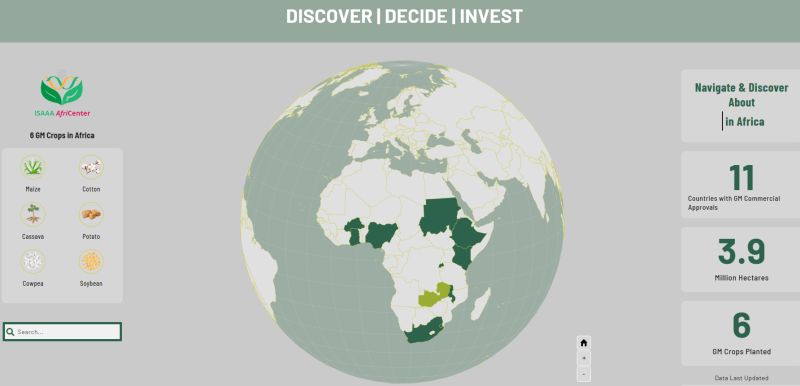
Africa has taken a major step toward standardizing agricultural trade and policy with the launch of a new continental digital portal designed to centralize biotechnology and biosafety information. The newly unveiled platform, known as the Biotech Africa Database, is designed to provide country-specific information on biotechnology crop approval decisions and key regulatory requirements governing the import, export and transit of biotech products.
Developed by the International Service for the Acquisition of Agri-biotech Applications (ISAAA AfriCenter) with the support of regional partners, the new platform consolidates accurate, up-to-date biosafety regulations to streamline decision-making for traders, researchers, and policymakers alike.
According to ISAAA AfriCenter, for years, biotechnology and biosafety information relating to Africa has remained fragmented across multiple agency websites, gazette notices and regulatory documents, making it difficult for users to access and interpret. This situation has often resulted in delays, compliance risks and uncertainty for traders, regulators and other value-chain actors operating across the borders.
Speaking during the launch, Director of ISAAA AfriCenter, Dr. Margaret Karembu, described the initiative as a significant milestone in leveraging digital data for regulatory decision-making on the continent.
“Today, we have opened a door where data replaces rumours, where a farmer in Kampala sees the same biotech information as a researcher in Kaduna, a trader in Johannesburg and a policymaker in Addis Ababa,” Dr. Karembu said.
She noted that the platform would be particularly beneficial to traders, regulators, researchers and other stakeholders who require quick and reliable access to regulatory approval decisions and biosafety information.
In Africa, Nigeria has commercially approved three biotech crops: bollworm-resistant cotton, pod-borer-resistant cowpea, and insect-resistant, abiotic stress-tolerant maize. Nigeria also permits the importation of genetically modified wheat and soybean strictly for food, feed and processing purposes.
Globally, more than 20 biotech crops are cultivated in 31 countries, with the total area planted to genetically modified crops reaching 218.71 million hectares. An additional 29 countries import biotech products or crops for food, feed and processing.
Currently, 10 African nations have approved six major biotech crops including cassava, cotton, cowpea, maize, potato, and soybean engineered for traits such as drought tolerance, pest resistance, and enhanced nutritional value.
In July 2024, Ghana made history by approving the commercial release of the Pod Borer Resistant (PBR) Cowpea, also known as Bt Cowpea. Developed by the CSIR-Savanna Agricultural Research Institute (SARI), this marks the country’s first-ever genetically modified (GM) crop. It is specifically engineered to resist the Maruca vitrata pod borer, a devastating pest that can destroy up to 80% of harvests.
Farmers across Ghana are only awaiting the official rollout of the Bt Cowpea (Songotra T) for commercial cultivation.
Experts say agricultural biotechnology has played an important role in improving livelihoods in developing countries, benefiting more than 17 million smallholder farmers through increased yields and reduced reliance on costly chemical inputs. These gains, they note, have contributed to more stable and resilient farming communities.
Biotech crops have been developed with traits such as drought tolerance, pest and disease resistance, enhanced nutrition, increased productivity and herbicide tolerance. Africa currently cultivates approximately 3.98 million hectares of biotech crops, representing nearly two per cent of the global biotech crop area.
For more information about the new continental digital portal designed “Biotech Africa Database platform”, launched visit https://biotechafrica.org/
Story by:
Nana Yaw Kesseh