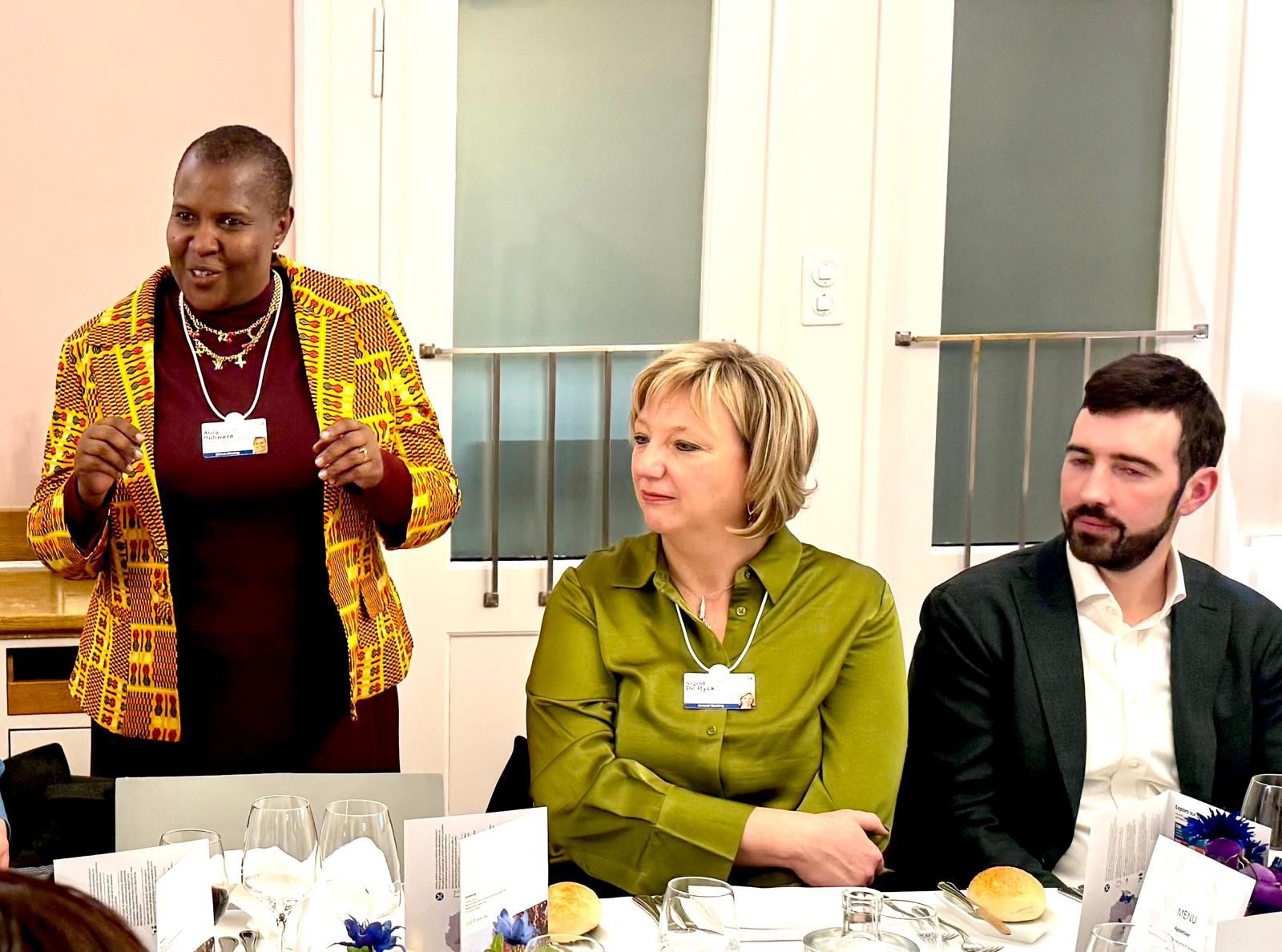
AGRA President Alice Ruhweza is calling for increased investments in smallholder farmers to help build resilience in global food systems. Speaking on the sidelines of the World Economic Forum in Davos, Switzerland, she said; “When smallholder farmers earn viable incomes, adoption sticks, markets stabilize and food systems become investable.” “If smallholder farmers were a country, they would be the world’s largest underperforming economy, and its biggest opportunity,” Ms. Ruhweza added.
Africa’s food system is projected to be worth USD1 trillion by 2030, driven by rising demand, value-chain opportunities, exports and technology. Ms. Ruhweza says food systems are at the heart of issues around agriculture, energy, health, climate, nature, among others. “Getting it (food systems) right for Africa’s farmers will lift people out of poverty, get children to school, put more nutritious meals on the table, and improve opportunities for women and youth,” she said during a meeting with global agricultural leaders at the end of the forum.
AGRA says its research shows when farmers cross an annual income threshold of roughly USD 1,200, behaviour changes. Farmers reinvest, productivity improves and agriculture begins to function as a business rather than a safety net. However, farmers operating below break-even cannot sustain new practices or technologies in agricultural production.
AGRA’s work in Africa
The AGRA team was in Davos to among others, launch a year-long reflection on 20 years of operations in Africa’s agri-food sector. Ghanaian diplomat and former United Nations Secretary-General, the late Kofi Annan, was the first board chairman of AGRA. After decades of working alongside governments, farmers and markets across Africa to improve Africa’s agriculture, AGRA is using its 20th anniversary year to sharpen the case for scale, translating evidence into investable pathways that can raise farmer incomes, strengthen food systems and unlock shared prosperity across the continent.
Over the past two decades, AGRA and its partners have helped governments and markets improve access to quality seeds, soil health solutions, extension services and policy reforms across Africa. Since its founding, AGRA has supported the release of more than 700 improved crop varieties, many bred to withstand drought, pests and disease, while working with governments and regional bodies to advance seed and fertilizer policy reforms that lower costs and expand access to inputs.
Evaluations conducted by Mathematica, drawing on farmer surveys and secondary data from the Food and Agriculture Organization and other sources, show increased adoption of improved seed, productivity gains and income growth in AGRA focus countries.
AGRA is calling on governments, investors and partners to align capital, policy and delivery around one organising principle: “farmer income is the metric that makes food systems resilient, investable and sustainable.” Ms. Ruhweza is also challenging African governments to invest more in the sector. “I would like to see African governments contribute that 10% that they have been promising to agriculture… But also take the sector more seriously,” she said. “This sector is the engine of Africa’s economic growth. It is Africa’s biggest employer. It feeds us. It feeds the world,” she added.
[1/28, 4:41 AM] Gakpo: AI will shape the future of food – AGRA President
AGRA President Alice Ruhweza says artificial intelligence (AI) is a defining force that is already reshaping the future of agricultural sector, and Africa must be at the fore front of that. Speaking on the sidelines of the World Economic Forum in Davos, Switzerland, she said “AI is the big subject. And AI for agriculture and AI for food has been in many discussions. I think the future of food systems is going to be very much technology and data driven. Many panels I was in, we kept talking about the fact that we need to embrace this. It is coming,’ she said.
Ms. Ruhweza however cautioned that while AI will transform food systems, its value will ultimately depend on how equitably and practically it is applied. “We need to make sure that when it comes, that the benefits are spread. And that everybody understands it. But importantly, that it solves the problem. Because we don’t want farmers to adopt AI unless it solves a problem,” she said.
The AGRA president identified access to financing and decision-making information as two areas in food systems that AI could help improve. “We want to make sure AI makes access to information easier. It makes credit scoring easier for women farmers who need access to finance,” she said. “We need to make sure that regenerative agriculture that we want to introduce, that we are getting the data that we need that tells us these are the farming practices that we need to do. So, I think the future of food systems will be data driven. But that future is in Africa,” the AGRA President added.
The World Economic Forum’s Annual Meeting 2026 in Davos, Switzerland, was under the theme “A Spirit of Dialogue.” World leaders from government, business, civil society and academia convened to engage in forward-looking discussions to address global issues and set priorities.
The conversations about artificial intelligence gained traction at the meeting. The world’s richest man and CEO of Tesla, Elon Musk, arge that if AI, robotics and solar power are deployed more broadly, they could unlock an era of unprecedented global abundance. “If you have ubiquitous AI that is essentially free or close to it and ubiquitous robotics, you will have an explosion in the global economy that is truly beyond all precedent,” he said. He said robots could perform industrial tasks, care for ageing populations and support families, addressing labour shortages while lowering costs.