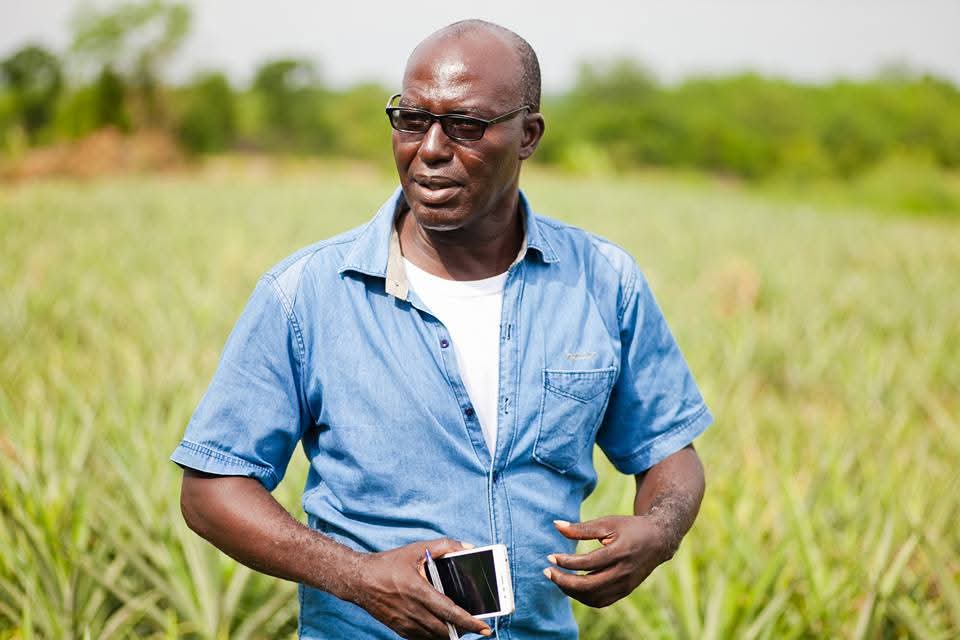
To end Ghana’s over-reliance on donor funding for its agricultural growth, Mr Joseph Kwesi Sarpong, a freelance Agricultural Technical Vocational Education and Training (ATVET) consultant and a retired MOFA staff member, is proposing a long-standing funding module for the country’s food sustainability with a 1 per cent tax levy.
According to Mr Ssrpong, despite agriculture being the backbone of the Ghanaian economy and the pivot on which all economic activities revolve, its development remains dangerously tethered to external donor cycles, a situation he describes as worrisome. It’s time we fund the backbone of the country ourselves, he emphasised.
This proposal provides a strategic justification for the introduction of a dedicated agricultural tax element in Ghana. It addresses the current over-reliance on donor funding and proposes a sustainable, internal financing mechanism to drive the “Agricultural Revolution” envisioned in the 2026 Budget, he stated.
He noted that the 2026 budget has increased to GH₵ 13 billion, yet a substantial portion of development projects remains donor dependent. This note proposes the Ghana Agricultural Development Levy (GAD-Levy) to create a self-sustaining Agricultural Development Fund (ADF), ensuring long-term food security and industrialization.
The above statement is contained in the memo addressed to the Chief Director of the Ministry of Food & Agriculture (MoFA). The memo dated 10th May, 2026, was entitled “Establishing the Ghana Agricultural Development Levy (GAD-Levy) via a 1% tax reallocation”
He justifies the request for the GAD-Levy through the lens of agriculture’s symbiotic relationship with every other sector with the following key sectors which enjoy taxes for development
Arguing that, health, Getfund and Tourism are enjoying tax policy, so why can’t we do the same to safeguard our backbone rather than depending on external hands for the agricultural sector.
Value Added Tax (VAT): The standard rate is 15%.
National Health Insurance Levy (NHIL): 2.5%
Ghana Education Trust Fund Levy (GETFund): 2.5%
Tourism levy: 1%
The Solution: The “Green Slice” Reallocation
I propose the introduction of the GAD-Levy, structured ‘not as a new tax burden’, but as a mandatory 1% reallocation of existing tax revenue.
- Mechanism: Directing 1% of the total pool of currently collected taxes (VAT, Corporate Tax, etc.) into a ring-fenced Agricultural Development Fund (ADF).
- The Logic: This is a revenue-neutral shift. It requires no new legislation to tax the public further, avoiding the “tax fatigue” complaints common in the current economic climate, while ensuring the engine of our economy is fuelled by our own resources.
Why This is Necessary Now
- Ending Donor Dependency: Ghana must transition from charity-based growth to sovereign-funded industrialization. We cannot build “Ghana” if our most vital sector relies on aid.
- Closing the $1.9bn Gap: Dedicated internal funds are the only way to tackle the massive annual post-harvest losses and bridge the infrastructure gap (e.g., farm-to-market roads and sea-transport corridors for produce).
- Economic Multiplier: Strengthening agriculture via this 1% pivot will lower food inflation, stabilize the Cedi by reducing food imports (rice, poultry, oil), and provide raw materials for local industry.
- Proposed Use of Funds
The GAD-Levy will be strictly applied to high-impact “backbone” projects:
- Infrastructure: Cold-chain storage and sea-taxi logistics (e.g., Takoradi-Axim-Tema corridor)
- Skills: Competency-Based Training (CBT) to professionalize the youth in the sector.
- Market Stabilization: Fully capitalizing the National Food Buffer Stock Company to protect both farmers and consumers from price volatility.
- Extension Services: Mobilizing and digitizing extension services to ensure farmers receive the technical support required to increase productivity.
- Others – (key activities)
This 1% reallocation is a bold, “common-sense” policy shift that honours the taxpayer, empowers the Ministry, and secures the nation’s food future. We all know that as long as our development budget is tied to donor signatures, we can’t truly plan for the long term. I’ve put together a concept for a ‘Green Slice’—a 1% reallocation of existing taxes—that gives MoFA the sovereign funding it deserves without asking the public for a single extra Cedi. A tax element for agriculture is actually an investment in Industry. By reallocating that 1%, you aren’t just helping farmers; you are ensuring that Ghanaian factories have the raw materials they need to stop importing expensive substitutes. You are moving Ghana from being a “price taker” in the global market to a “value maker.” The Bottom Line: Industry and Agriculture are two sides of the same coin. You cannot have a 21st-century “Industrialized Ghana” without a 21st-century.
He concluded by saying that the introduction of a tax element for agricultural development is not a burden; it is an investment in survival. By creating an internal revenue stream, Ghana can finally bridge the gap between “potential” and “productivity,” ensuring that the sector truly serves as the engine of the nation’s economic transformation.
He recommends the Conduct of a 6-month stakeholder consultation with the Ghana National Association of Farmers and Fishermen (GNAFF) to refine the levy rates before inclusion in the 2027 Mid-Year Budget Review.
Source:
Mr Joseph Kwesi Sarpong, a freelance Agricultural Technical Vocational Education and Training (ATVET) consultant who is also a retired MOFA staff member, worked briefly with GIZ, Ghana