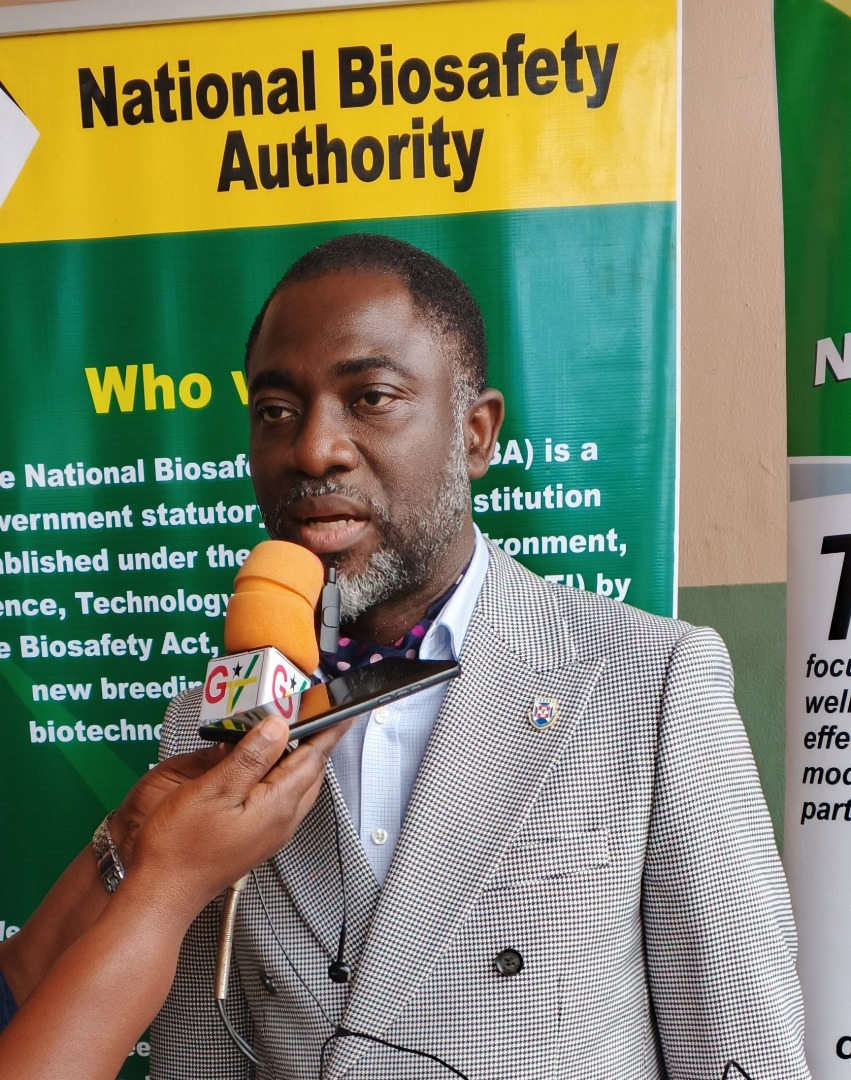
 The National Biosafety Authority (NBA) has held a stakeholder engagement in Accra focused on introducing its new requirements for Non-GMO certification and GMO detection and identification services, as well as presenting its proposed revision of Free on Board (FOB) regulatory fees and charges.
The meeting forms part of NBA’s commitment to create broader awareness of its services and build consensus around the revised fees and charges, aimed at boosting compliance and strengthening biosafety oversight in Ghana’s food and feed industry.
The engagement also served as a platform to discuss sector-specific concerns and pragmatic solutions to strengthen biosafety regulation in Ghana.
The stakeholder engagement brought together over 30, farmers, processors, exporters, importers, academia, consumer groups and civil society within the food and feed industry.
Presentation
Updating stakeholders on Non GMO certification, GMO detection and identification, as well as the introduction of a Free on Board (FOB) based regulatory fee structure, Chief Executive Officer of the NBA, Kwame Dei Asamoah Okyere said the Authority is committed to safeguarding the public through robust regulation of modern biotechnology, including genetically modified organisms (GMOs).
He announced improvements in application procedures, the introduction of a clear system for non-GMO certification, and enhanced processes for GMO detection and identification.
According to him, the National Biosafety Authority (NBA) has stepped up efforts to strengthen public trust in its work, unveiling a series of reforms aimed at improving transparency, streamlining processes, and deepening awareness of biosafety issues in Ghana.
“As Ghana continues to position itself in regional and global trade, a credible and traceable non GMO certification system, backed by robust testing mechanisms, becomes critical.
“This engagement reaffirms NBA’s proactive role in protecting public health, empowering informed consumer choices, and ensuring compliance that benefits both producers and consumers.
“The NBA is the national competent agency mandated by the Biosafety Law,201l (Act 831) to ensure the safety and effectiveness of genetically modified plants and animals, and their derivatives, in particular food and feed during their development, transportation, handling and use to safeguard public health and safety of the environment. This meeting is aimed at creating awareness of our services, building consensus and ownership of proposed revised fees and charges to enhance compliance with regulations.
It will also serve as a platform to discuss sector-specific concerns and pragmatic solutions to strengthen biosafety regulation in Ghana.
“We are working to ensure that our processes are transparent, credible, and accessible to all,” he said. “Your safety is our priority, and we will continue to strengthen public education so that people know exactly what we are about” he said.
Professor Chaos Toto, Director of the CSIR Food Research Institute, described the session as an “eye-opener,” praising the NBA for sharing detailed updates on its work and calling for more regular engagements.
“This has been an excellent platform for us to understand the Authority’s activities and help communicate them to the public,” he said.
Support
In his remarks, Hon. John Darko, Member of Parliament for Suame, praised the NBA’s decision to cut charges. He emphasised that such reforms should go through proper parliamentary and ministerial channels to ensure the Authority secures the resources it needs.
“These changes will be welcomed by many in the field,” he said, “but it is important that government continues to consult stakeholders before implementation to avoid backlash.”
Project Officer, Open Forum on Agricultural Biotechnology (OFAB) Ghana, described the proposed fee reductions as a positive step for biotechnology in the country. He noted that lower costs will remove excuses for bypassing the official process, thereby ensuring that products on the market have gone through the necessary safety checks.
Appreciation
Participants acknowledged the progress made by the NBA but underscoring the need for stronger outreach. They noted that many citizens, particularly farmers and rural communities, have little knowledge of biosafety issues.
The Authority pledged to refine its communication strategy, especially on social media and through market and school outreach, so that every Ghanaian will not only recognise the NBA’s name but also understand its role in ensuring biosafety in Ghana.
Story by:
Nana Yaw Reuben