
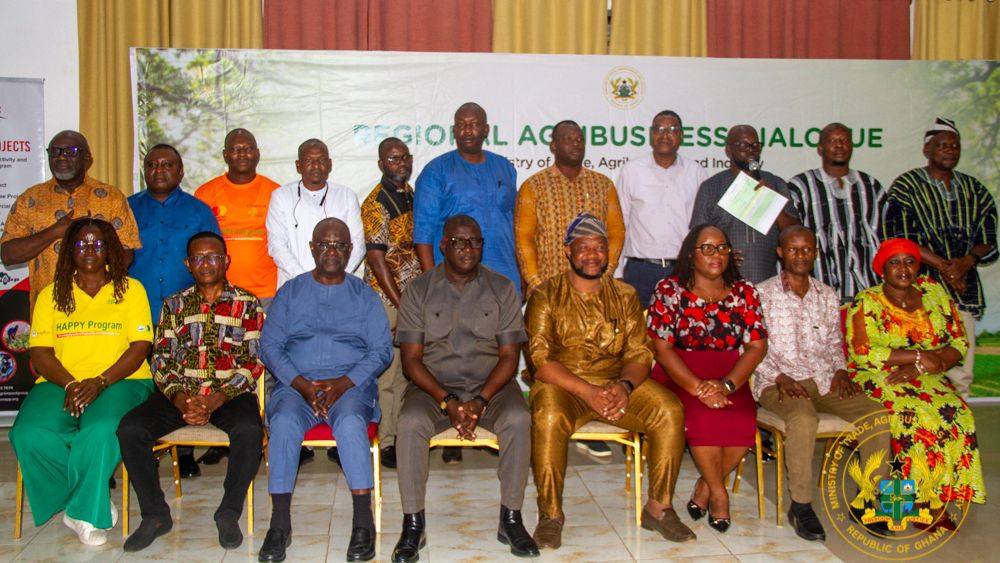
The Deputy Minister for Trade, Agribusiness and Industry, Hon. Sampson Ahi has reaffirmed government’s commitment to repositioning the agribusiness sector as a major pillar for Ghana’s industrial transformation and the envisioned 24-hour economy.
The speech, delivered on his behalf by Mr. George Owusu Ansah Amoah, Director of Research, Statistics and Information Management Directorate (RSIM) at the Ministry, was read at the Regional Agribusiness Dialogue held on Tuesday, 9th December 2025 at the Global Dreams Hotel in Tamale.
Addressing representatives from academia, development partners, industry captains, and agribusiness stakeholders, the Deputy Minister noted that Ghana stands at a defining moment as global agribusiness opportunities continue to expand. He referenced projections that the global agribusiness market — currently valued between US$3.4 trillion and US$3.5 trillion — is expected to reach between US$4.4 trillion and US$5.8 trillion by 2033.
“We have a unique opportunity to tap into this expanding market through innovation, value addition, contract farming and sustainable agribusiness practices,” he stated.
Hon. Ahi explained that the realignment of the Ministry from the Ministry of Trade and Industry to the Ministry of Trade, Agribusiness and Industry signals a deliberate government shift toward strengthening linkages between agriculture and industry.
According to him, many local industries continue to operate below optimal capacity — some between 30 and 40 percent — due to limited access to raw materials, weak value chains, and post-harvest inefficiencies. Strengthening agribusiness systems, he said, is necessary to reverse this trend and support Ghana’s industrial competitiveness.
The Deputy Minister highlighted three major programmes — the Feed the Industry Programme, the Rapid Industrialization Programme, and the Accelerated Export Development Programme, as engines for Ghana’s industrial expansion.
The Feed the Industry initiative, he explained, is expected to improve raw material supply consistency for factories, and increase industrial capacity utilization to between 70 and 80 percent through a hub-and-spoke system that links smallholder farmers, commercial farms, and processors via contract farming.
The programme will be anchored on four pillars:
1. Commercial Farmer Development and Value Chain Integration
2. Post-Harvest Solution Centers and Processing Infrastructure
3. Industrial Linkages and Market Development
4. Programme Management and Institutional Development
To support agro-industrialization, Hon. Ahi announced a two-phased strategy for agricultural machinery access.
“In the short term, government will waive taxes on agro-processing machinery to lower costs and incentivize investment,” he revealed.
In the medium-to-long term, government will scale up domestic production of agro-processing machines through capacity development at the GRATIS Foundation under the Rural Enterprise Programme of the Ministry, in collaboration with IFAD.
The Deputy Minister also disclosed that the Ministry is developing a National Agribusiness Policy to guide the sector’s future. Regional consultations, including the one held in Tamale, are being used to gather region-specific priorities to ensure a policy that is inclusive, sustainable and aligned with national development goals.
Hon. Ahi encouraged stakeholders to take ownership of the emerging policy framework and work together to build a resilient agribusiness ecosystem.
“If we work together, we can unlock the full potential of agribusiness, create jobs, boost exports, and secure a prosperous future for Ghana,” he said.
The Regional Agribusiness Dialogue forms part of ongoing engagements across the country aimed at shaping a comprehensive national policy framework for agribusiness-led industrial development.
In a speech read on his behalf, the Northern Regional Minister, Ali Adolf John, describe Agribusiness as more than just a means of substance, it is a vital component of the Ghanian economy and an essential driver of local development, stressing that ” In the Northern region our Agribusiness sector is not only a source of livelihood for thousands but also plays a crucial role in food security and national growth”.
Mr Daniel Acquaye, Group CEO of Agri impact limited, urged stakeholders to bring their expertise on board to ensure the sustainability and inclusivity of the Agribusiness policy to benefit all and help reset the Agribusiness space.
He further called for the deepening of Agricultural and Agribusiness infrastructure to promote the industry and ensure value for money.
The Tamale dialogue follows a serious of dialogues been organised by the Ministry and its partners to obtain and solicit the necessary input and contributions for and inclusive policy to guide and align with the industry.
The dialogue in Tamale discussed topical issues relating to the Agribusiness including access to market and trade.
Source: PR & COMMS UPDATES – MOTAI